
Freelancers often manage multiple roles at once.
They are:
- Writers
- Marketers
- Customer support agents
- Project managers
Handling all these responsibilities manually can quickly become overwhelming.
Artificial Intelligence can support freelancers by improving efficiency across multiple areas — without reducing quality.
This case study explores how a multi-service freelancer can use AI to increase productivity responsibly.
The Scenario
Consider a freelancer offering:
- Content writing
- Social media management
- Basic marketing support
The freelancer works with multiple clients and faces challenges such as:
- Tight deadlines
- High communication volume
- Research-intensive tasks
- Content planning pressure
Without structure, workload quickly becomes unmanageable.

Step 1 — Streamlining Research
The freelancer begins by using AI to accelerate research.
Instead of spending hours reading multiple sources, they ask:
“Summarise key trends in digital marketing for small businesses.”
AI provides structured insights.
The freelancer then verifies and expands the information before using it in client work.
This reduces research time significantly.
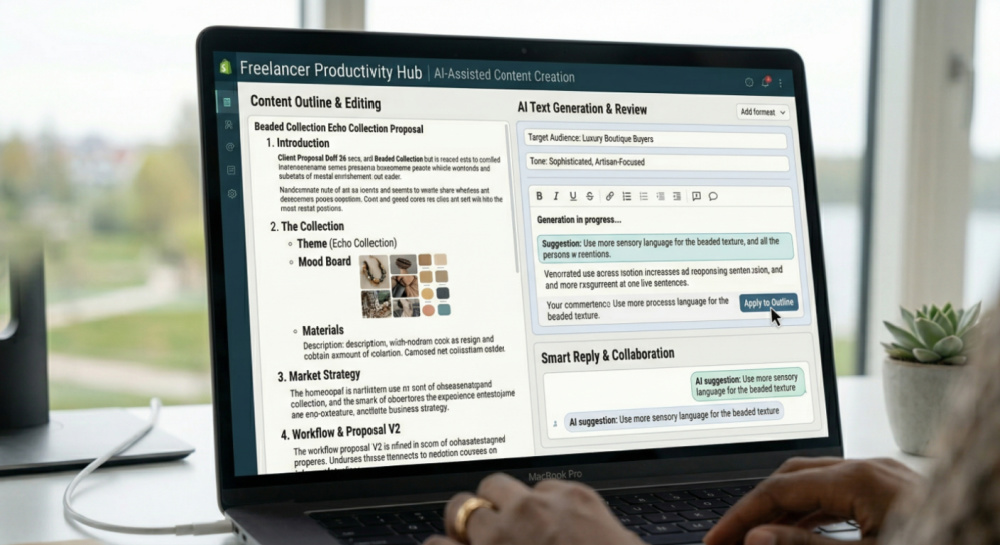
Step 2 — Structuring Content Efficiently
For writing tasks, the freelancer uses AI to:
- Generate outlines
- Suggest headings
- Organise ideas
Example prompt:
“Create a structured blog outline about social media marketing for small businesses.”
The freelancer writes the content independently using the outline as a guide.
This improves speed without sacrificing originality.
Step 3 — Managing Client Communication
Freelancers often spend significant time replying to messages.
AI helps by:
- Drafting responses
- Improving tone
- Structuring updates
Example prompt:
“Rewrite this client update in a clear and professional tone.”
The freelancer reviews and personalises each message before sending.
This maintains professionalism and efficiency.
Step 4 — Planning Weekly Workload
Using AI, the freelancer creates a weekly plan.
Example prompt:
“Create a weekly task plan for managing three clients with writing and social media tasks.”
AI suggests:
- Task breakdowns
- Time allocation
- Priority levels
This improves organisation and reduces stress.

Step 5 — Repurposing Content
AI allows the freelancer to reuse content across formats.
For example:
- A blog post becomes social media content
- A long article becomes short captions
- A report becomes client updates
Example prompt:
“Convert this blog post into five social media captions.”
This increases productivity without duplicating effort.
Maintaining Quality and Control
Despite using AI, the freelancer remains responsible for:
- Accuracy
- Originality
- Client expectations
- Brand voice
AI is used as:
- Assistant
- Editor
- Idea generator
Not as a replacement for expertise.
Benefits Observed
When used responsibly, AI-assisted workflows can:
- Reduce working hours
- Improve organisation
- Increase output consistency
- Enhance communication quality
This allows freelancers to scale their work more sustainably.
Practical Limitations
Freelancers must remain aware of:
- AI inaccuracies
- Over-reliance risks
- Generic content generation
- Client confidentiality concerns
Critical thinking remains essential.
Lessons From This Case Study
Key takeaways:
- AI improves efficiency across multiple tasks.
- Structure is more important than tools.
- Human oversight ensures quality.
- Productivity increases when AI is used consistently.
Final Reflection
Freelancing is not becoming easier — it is becoming more competitive.
Artificial Intelligence gives freelancers an advantage, but only when used responsibly.
Freelancers who combine:
- Skill
- Structure
- Consistency
- AI support
will be better positioned to succeed in a global market.