
Small businesses often struggle with one critical challenge: consistent communication with customers.
Messages arrive through multiple channels:
- Social media
- Website contact forms
Responding quickly and professionally can become difficult, especially when the business owner is also handling operations, sales, and finances.
Artificial Intelligence can support small businesses by improving communication efficiency without removing the human touch.
This case study illustrates how a typical small business could integrate AI into its customer communication workflow.
The Scenario
Consider a small retail business selling handmade products.
The business receives daily messages such as:
- Product availability questions
- Pricing requests
- Delivery inquiries
- Custom order requests
The owner often spends hours replying to similar questions repeatedly.
This reduces time available for production and business development.
The Communication Challenge

Without structured communication, small businesses often face:
- Delayed responses
- Inconsistent messaging
- Missed inquiries
- Customer frustration
Customers increasingly expect fast and clear responses.
AI tools can assist in preparing structured replies while allowing the business owner to remain in control.
Step 1: Creating Response Templates With AI
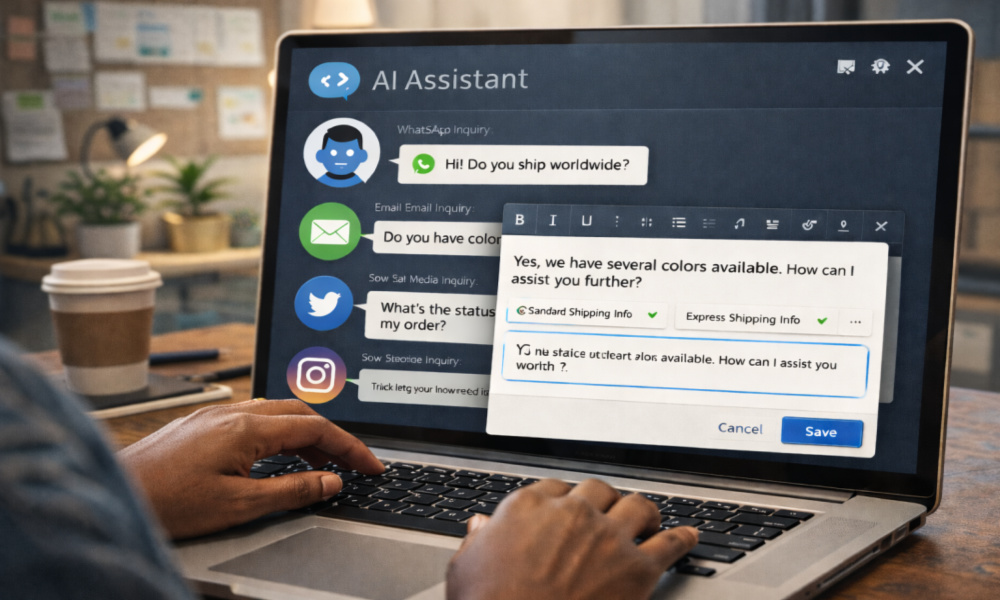
The business owner can ask an AI assistant:
“Help me create polite response templates for common customer questions about product availability, pricing, and delivery.”
AI can generate structured replies such as:
- Availability confirmation messages
- Delivery explanation messages
- Order instructions
The owner reviews and adjusts the templates before using them.
This reduces repetitive typing.
Step 2: Improving Message Clarity
Many small business messages are written quickly, sometimes leading to unclear communication.
AI can help refine messages.
Example prompt:
“Rewrite this customer response in a friendly and professional tone.”
This ensures:
- Consistent language
- Professional tone
- Clear instructions
Customers perceive the business as more organised.
Step 3: Managing High Message Volume
When messages increase, AI can assist by:
- Summarising long conversations
- Suggesting quick replies
- Structuring follow-up messages
The business owner still sends the final message manually, maintaining authenticity.
Step 4: Supporting Multilingual Communication
In many African markets, businesses communicate with customers who speak different languages.
AI can assist with translation and clarification.
For example:
- English
- French
- Local languages (where supported)
This improves accessibility and customer reach.
Maintaining Human Control
AI should assist communication, not automate it entirely.
Small businesses should always:
- Review messages before sending
- Maintain personal tone
- Respond personally to complex inquiries
Customers still value human interaction.
Benefits Observed
When used responsibly, AI-assisted communication can produce several benefits:
- Faster response times
- More consistent messaging
- Reduced workload
- Improved professionalism
These improvements strengthen customer trust.
Practical Limitations
AI is not perfect.
Small businesses must remain aware of:
- Possible inaccurate suggestions
- Tone adjustments required for specific customers
- Data privacy concerns when sharing information
Responsible oversight is essential.
Lessons From This Case Study
Several key lessons emerge:
- AI works best when assisting repetitive tasks.
- Human review remains essential.
- Templates improve efficiency dramatically.
- Professional communication strengthens customer trust.
AI should support business operations — not replace personal engagement.
Final Reflection
Artificial Intelligence offers practical tools that small businesses can adopt without large investments or complex systems.
When used carefully, AI can help small businesses:
- Save time
- Improve communication
- Strengthen professionalism
- Focus on growth
Technology becomes valuable when it supports human effort rather than replacing it.
To explore more practical ways Artificial Intelligence can be applied in everyday situations, visit the AI for Daily Life section.
Explore more real-world applications:
- How Students Can Use AI to Study More Effectively
- How Freelancers Can Increase Productivity Using AI
- How Professionals Can Increase Workplace Productivity