
Artificial Intelligence is increasingly becoming part of modern education.
Students around the world are using AI tools to help them understand complex topics, organise study schedules, and prepare for exams.
However, the most effective use of AI in education is not about replacing learning — it is about supporting understanding and improving study habits.
This case study illustrates how a student could integrate AI responsibly into a structured study routine.
The Scenario
Consider a university student studying economics.
The student faces common challenges:
- Large reading assignments
- Difficult concepts
- Limited time before exams
- Multiple subjects competing for attention
Traditional study methods still work, but AI can act as a study assistant that accelerates comprehension.
Step 1 — Clarifying Difficult Concepts
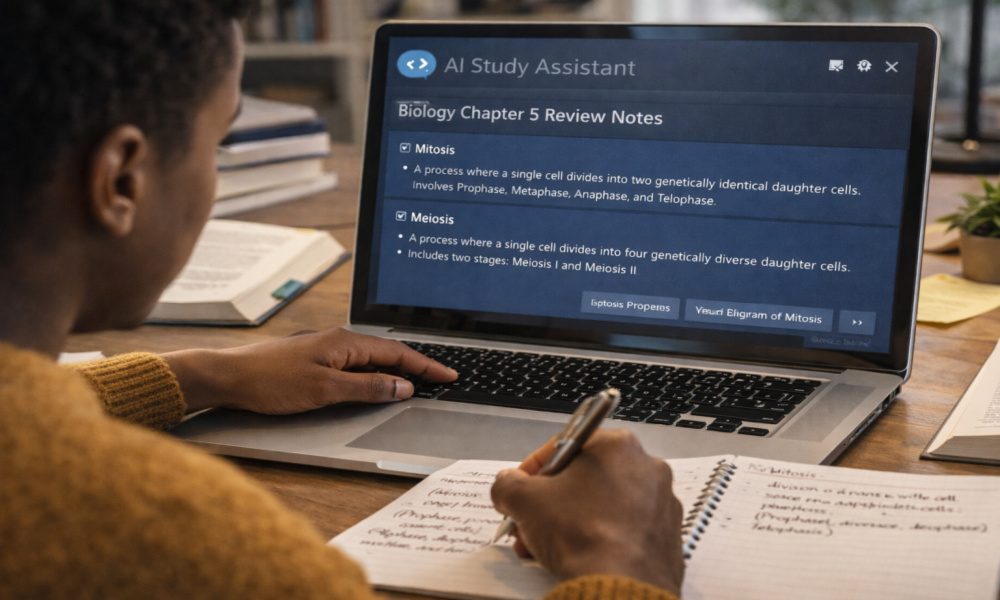
Instead of spending hours searching multiple websites, the student can ask AI tools to explain complex topics in simpler language.
Example prompt:
“Explain inflation and monetary policy in simple terms for a first-year economics student.”
AI can provide:
- Simplified explanations
- Examples
- Analogies
The student still reads textbooks but gains faster clarity.
Step 2 — Generating Study Summaries
AI can help summarise long chapters into structured notes.
For example:
“Summarise the key points from this chapter about supply and demand.”
This helps students identify:
- Key concepts
- Definitions
- Core theories
However, the student should review the original material to confirm accuracy.
Step 3 — Creating Practice Questions
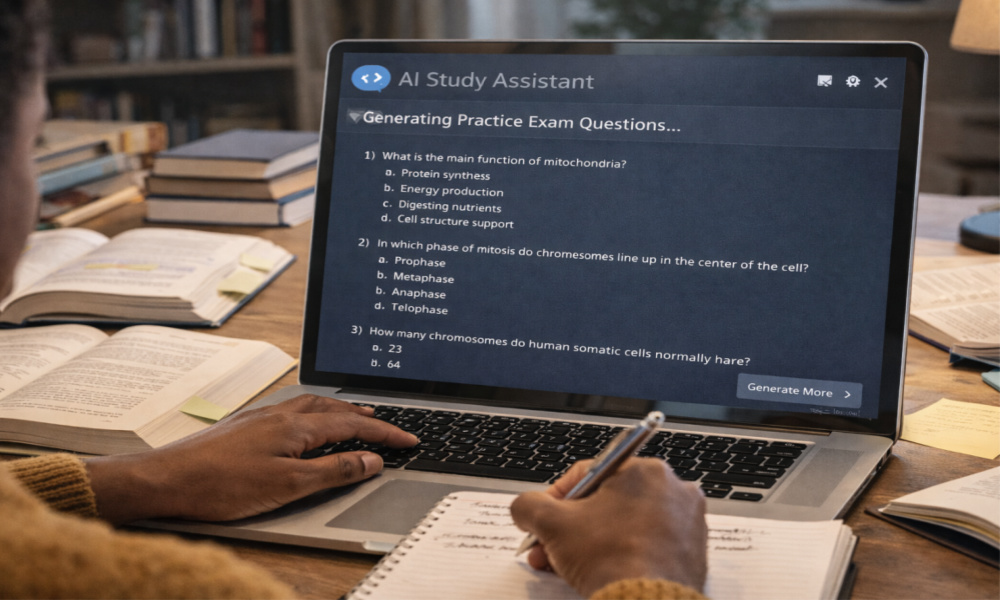
Practice is essential for learning.
Students can ask AI to generate:
- Quiz questions
- Flashcards
- Multiple-choice tests
- Essay prompts
Example prompt:
“Create ten practice questions about market equilibrium.”
This allows the student to test their understanding before exams.
Step 4 — Structuring Study Plans
AI can help organise study schedules.
Example prompt:
“Create a two-week study plan for preparing for an economics exam.”
The result may include:
- Daily topics
- Review sessions
- Practice exercises
This reduces procrastination and improves consistency.
Step 5 — Improving Essay Structure
Students often struggle with essay organisation.
AI can help by suggesting outlines.
Example prompt:
“Create an outline for an essay discussing the effects of inflation on economic growth.”
The student then writes the essay independently while using the outline as guidance.
Maintaining Academic Integrity
AI should never replace a student’s thinking or writing.
Responsible use means:
- Understanding AI explanations
- Writing assignments independently
- Verifying facts
- Avoiding plagiarism
Education develops reasoning ability.
AI should strengthen that process, not weaken it.
Benefits Observed
When used responsibly, AI-assisted study habits can lead to:
- Faster concept understanding
- More organised study schedules
- Improved exam preparation
- Reduced study stress
Students remain responsible for their learning.
AI simply improves efficiency.
Practical Limitations
Students must also recognise AI limitations.
AI systems may:
- Provide incorrect information
- Oversimplify complex topics
- Generate outdated references
Critical thinking and verification remain essential.
Lessons From This Case Study
Several lessons emerge:
- AI works best as a study assistant.
- Students must verify information independently.
- Structured study habits improve results.
- AI supports learning but does not replace effort.
Final Reflection
Artificial Intelligence can transform the way students approach learning.
When integrated into a structured study routine, AI can:
- Clarify difficult concepts
- Generate practice materials
- Improve study planning
- Reduce information overload
But the responsibility for learning remains with the student.
Technology enhances education when used responsibly and thoughtfully.
To explore more practical ways Artificial Intelligence can be applied in everyday situations, visit the AI for Daily Life section.